Contains spoilers
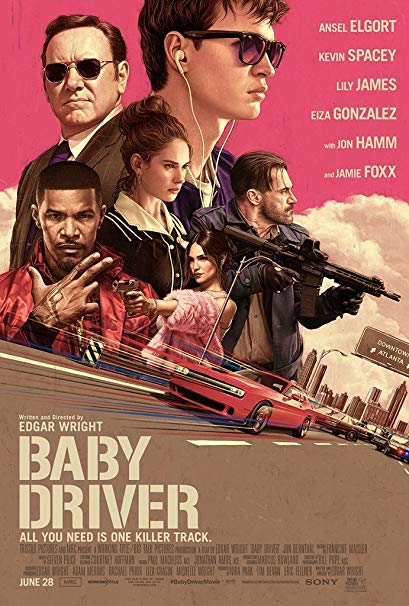
Baby Driver was easily my favourite film of 2017, and not without reason: it is an original take on a formulaic blend of car-chase/ heist thrillers, a musical romance with an intrusive soundtrack, and ultimately a masterful triumph. I am no film critic, but there are intrinsic details in the movie that demand careful appreciation even from a nobody’s viewing, regardless of the multiple BAFTAs, Academy Awards, Critics’ Choice and a Golden Globe. Here I endeavour to unravel precisely why Edgar Wright hits all the right notes. If you haven’t watched the film, please do.
Simon and Garfunkel’s 1964 song Baby Driver perfectly captures the idea behind Edgar’s two-decade long passion project. ‘And I was born one dark gray morn with music coming in my ears. They call me Baby Driver. And once upon a pair of wheels I hit the road and I’m gone.’ The music of Baby Driver is what immediately captures our attention, and prevalent as a story-telling device throughout the film. I’ll save you from the endless praise about the musical device in Baby Driver-you can read that from countless professional reviews, but hear me out on a few gems of cinematic brilliance.
How does the music tell the storytelling? The famous opening scene says it all. 6 minutes with a no-dialogue, car-chasing action set in sync to Wright’s inspiration for the film- Bellbottoms by The Jon Spencer Blues Explosion. He had previously done a music video for Mint Royale’s Blue Song and the resemblance is uncanny. ‘When I listen to this song, I think of a car chase.’ Every jump, every cut is synced in time to the song, and Baby’s playful lip-syncing as he awaits the robbers’ return prepares us for a musically-infused thriller. Wright scripted the film directly to music he hand-picked, ignoring Quentin Tarantino’s warning against his unconventional method, saying it was too hard to secure rights to the music. Undeterred, Wright instructed his crew to completely follow the track when filming and this was fundamental to its success.
The tracking shot set to Harlem Shuffle by Bob & Earl was specifically edited by British DJ OSYMYSO to blend in to the sounds of the street, and choreographed with the help of Grammy-winning choreographer Ryan Heffington. Wright went to extreme lengths in order to merge film to music, one example being the added scene when Baby restarts the track on his iPod after changing cars because Neat Neat Neat by the Damned was too short to fit the scene. Baby Driver has become a masterclass in editing to the music, with many spotting the brilliance of Focus’ Hocus Pocus as the ‘perfect cardio track’ for the ever-changing tempo of the foot-chase scene, and the drums in The Button Down Brass’ Tequila synced to the gunshots in the action-packed gunfight.
Not only that, but critics have also noticed the combination of visual language and music to represent Baby’s form of escapism. Following his mother’s death, Baby listens almost constantly to music in order to drown out the grief. Interestingly, when Debora comes into his life, he no longer needs the constant music in his ears. Coincidence? I think not. Another manipulation of music and video editing is the long sweeping shots of non-chase scenes set to classical music compared to heavy rock action scenes, highlighting the drastic difference between Baby’s two worlds. The colour(and music)-coordinated turning of the washing machines in the Laundromat, the graffiti of matching lyrics, Buddy’s revenge scene set to Baby’s favourite song Brighton Rock by Queen and the lyrical detail ‘nowhere to run, Baby’ are merely the tip of the iceberg when it comes to musical details.
More in terms of storytelling: Baby’s morality and detest of violence is prevalent throughout, even in chase scenes- he edges the car forward to avoid seeing the robbery, and on multiple occasions save bystanders’ lives without jeopardizing the mission. Every detail serves a purpose in Wright’s film, and the high-flying car chases do not serve only to entertain thrill-seekers. We get the sense that Baby’s world is falling apart when during the drug deal, the camera averts from its persistent focus on only Baby and move to shots of the other characters, unprecedented in the entire movie.
Daniel Netzel from Film Radar also notes the use of colour-coded characters in Baby Driver. Costume designer Courtney Hoffman portrayed Baby’s innocence and alienation to his violent peers through his black and white costume. It epitomizes the contrast between his worlds and his old-fashioned, romantizised view of the world. This is also seen in the black and white nostalgic vision of his escape with Debora. Another Easter egg for you: Baby’s undershirt gets progressively darker to signify the collapse of his world.
The other characters’ costumes are also designed accordingly. Wright always remembered the effect the distinction of characters in his TV show Spaced had on his viewers. ‘The characters are all really easy to draw.’ Debora is dressed in the same black and white as Baby, representing innocence and goodness, whist some have noticed that she wears the exact same uniform that Baby’s mum had when she worked at the diner. Outside of work, Debora wears denim and the colour yellow, associated with happiness and literally brightening Baby’s black-and-white world. Bat’s vicious red echoes his violent character, with the colour also representing Buddy’s descent into madness as he is basked in red light from the police car in his final duel with Baby. Doc’s green is a common association with money and greed, yet his deep-seated attachment to Baby is seen through his nephew. The brief scene of the child depicts him in the same outfit as the young Baby in flashbacks: blonde hair, blue plaid shirt and earbuds.
Really these are blanket observations for a film with as much detail as Baby Driver, but with each new viewing, one should discover more and more of the ingenious intricacies of Edgar Wright’s work.
 finemargins.art