Why Bohemian Rhapsody is Such a Bloody Good Song

The crowd at Wembley were enchanted the moment Freddie Mercury sat down at his Steinway piano and started playing the famous ballad section to Bohemian Rhapsody. Queen’s performance at Live Aid 85 reaffirmed their place in Britain’s music history and helped turn a corner from uncertain times for the band. Bohemian Rhapsody became what was not only emblematic of Queen’s unforgettable legacy but also took on an identity of its own. I am here to examine the context and musical theory behind Bohemian Rhapsody’s success.

Queen – Bohemian Rhapsody (Live Aid 1985)

The release of Sheer Heart Attack and its hit single Killer Queen gave Queen the freedom to explore new ideas including song structures, abandoning the sure-fire verse/chorus formula and adopting something entirely radical: a rhapsody- an amalgamation of contrasting episodes each befitted with different ideas and structure; ‘a miniature operatic- rhapsodic- symphonic- tone- poem’[1] that fits into one coherent piece. Some even see a resemblance to Joseph Campbell’s The Hero’s Journey – a template of storytelling that goes back to ancient Greek myths. Each of these phases can be attached chronologically to each section of the song; the eerie a capella harmony at the start sets the inner conflict in ‘Refusal of the Call’, the piano ballad of an emotional ‘Road of Trials’, Brian May’s guitar solo descending into ‘the Abyss’ of operatic demons and the recapitulation of the ballad motif at the end of his epic journey. Queen’s experimentation of structure was a digression from conformity that helped Bohemian Rhapsody stand apart from other radio hits just as the Beach Boys’ Good Vibrations and the Beatles’ A Day in the Life had done.

The inclusion of an operatic section is no doubt unusual and hard to forget, but perhaps when we consider Queen’s identity this decision does not seem so surprising after all. By the mid-70s Queen had established itself as an icon of glam rock, embracing their extravagant, sexualized image both on and off stage. Bohemian Rhapsody’s fusing of rock and opera, two traditionally mutually exclusive genres with mutually exclusive audiences, is a reflection of this: ‘an analogous rejection of traditional cultural boundaries surrounding sexual orientation, gender and class’. There is actually also more than meets the eye when it comes to similarities between opera and rock. Vocal virtuosity, whether it is screaming or extreme octave leaps, and a preference for upper register singers, are consistent in both. Freddie Mercury’s vocal range and diverse timbre were perfectly suited to expressing the emotional tension in both operatic and rock elements in Bohemian Rhapsody. Lyrics such as ‘Silhouetto’, ‘Scaramouche’, ‘Fandango’, ‘Gallileo’, ‘Figaro’ and ‘Magnifico’ are a clear nod to the Italian tradition of opera. Paired with falsetto dialogue, homophonic chorus and fragmented phraseology, Freddie’s ‘mock opera’ is finally complete. Roger Taylor said that  as they added more to the song it became more and more ‘outlandish and ridiculous’ but that he always liked ‘the core of the song’ which was the verse ‘Mama, just killed a man…’. Kudos to Mercury’s band members for believing in his arrangement.

Bohemian Rhapsody’s presence on the charts, and more importantly its originality, was in part due to its music video: a first of its kind, a promotional tool made using a video outside broadcast track, normally used for sport at the time. ‘You might go to Top of the Pops but nobody had videos. Especially as a marketing tool for the single on video.’[2]  The frame of the video was inspired by an image from Shanghai Express, a 1932 film by von Sterberg, with actress Marlene Dietrich’s arms crossed and looking straight into camera in black and white. Queen’s album cover Queen II uses the same pose and same black background for chromatic contrast. Mick Rock, photographer of that photo: ‘It was the perfect image for Queen; fascinating, mysterious, classic… I believe to have been the only one who understood the dualism that was in their music: the light and shadow, white and black. There was always tension between these two poles. The result was strong and involving, like in dramatic opera.’ The setting was on a stage as if Queen were performing live, reinforcing Queen ‘s status as a live band. It also included special effects that matched the music, for example the cascading echoes with a ‘zooming’ effect produced using prism lenses. Before the recent biopic Bohemian Rhapsody, the song also featured more subtly, but no less memorably, in Spheeris’ Wayne’s World. The famous ‘head-banging’ scene helped promote the band’s music to audience across the pond and Bohemian Rhapsody subsequently rose to no.2 on Billboard.

The members of Queen were all classically trained in music. They paid an extraordinary amount of attention to detail in their writing and implemented lots of technical skills inspired by classical music. Tonal ambiguity and syllabic melody in the first a capella section creates a suspenseful mood. Mercury uses rhythmic tricks and line clichés to seamlessly transition between the polarizing sections. He also uses multiple motifs to maintain cohesiveness, such as the Bohemian motif that uses chromatic movement around the Bflat tonic key to build tension and the memorable cascading motif on ‘magnifico’ and ‘go’. The functional harmony used in Bohemian Rhapsody also offers a great insight into the sheer brilliance of Queen’s writing. There are examples of the Circle of Fifths of being used and complicated but nicely executed key modulations. Just as powerful, the triplets or ‘shuffle’ in the ‘head-banging’ section create drive and momentum. In the subtlety of Queen’s writing too, such as the sneaky change in the drums part from quadruple time to triplets to pre-empt the aforementioned section, the members manage to show off flashes of virtuosity without disrupting the purpose of the narrative, from Mercury’s cross-hands technique to May’s solo runs.

As meticulous as their writing can be, much is owed to Queen’s production method and creative persistence. They were not to first to experiment with sounds in the studio and play around with special effects such as a flanger, echo effect, panning (in ‘little high’ little low’), the ‘bells effect’ (on ‘magnifico’) and overdrive (Deacon’s specialised amp that made the guitars sound like trumpets). The members of Queen were huge fans of the Beatles and acknowledged them not only for musical inspiration but for production methods. The difference is that Queen had the benefit of experience and another decade’s worth of technological innovation. Much of the distinctive bombastic sound of Bohemian Rhapsody comes from a technique developed by Phil Spector in the 60s called the ‘Wall of Sound’. To create this wall of sound Queen tirelessly overdubbed their tracks again and again. May describes one instance where the bass guitar was overdubbed three times: once direct from the guitar, one from the amp, and one ‘out of the speaker into the room to get a bit of ambiance’. In the digital age of sound production it is perhaps difficult to appreciate just as ridiculous a feat it was to bounce 180 tracks onto a two-inch tape and how much foresight it required. To help battle this all tracks were played along to Freddie’s guiding vocals and his piano part; in other words the entire 5 minute 55 second song was already mapped out in utmost detail in Mercury’s head before a single note was sung.

For the producers the almost-6 minutes track was far beyond what was considered radio-friendly. ‘When they played me ‘Bohemian Rhapsody,’ my reaction was, ‘What the f***’s this? Are you mad?’” recalls EMI executive Paul Watts.[3] Well, thank god Queen were adamant in refusing to cut down despite heavy opposition, so that now we can enjoy Bohemian Rhapsody in all its fantastical glory.


[1] Service, T. (2009, December 8). Bohemian Rhapsody: Mama, we’ve killed a song. Retrieved November 16, 2018, from The Guardian: https://www.theguardian.com/music/2009/dec/08/bohemian-rhapsody-karaoke-hit

[2] Queen. (2002). Inside the Rhapsody. ‘Greatest Video Hits 1’ .

[3] Chiu, D. (2018, October 30). ‘Bohemian Rhapsody’ movie fact vs fiction: how events and people in movie differ from what really happened. Retrieved February 24, 2019, from https://ultimateclassicrock.com/queen-bohemian-rhapsody-movie-fact-vs-fiction/

The Sandman

We’ve all heard of the Sandman, from The Chordettes’s ‘Mr. Sandman’ to Metallica’s ‘Enter Sandman’, this mysterious figure creeps up time and again in pop culture. The 1955 barbershop hit depicts the Sandman as the bearer of dreams who turns on his magic beam and brings you a dream, and likewise in the heavy-metal band’s fifth album almost 17 years later. But who is the Sandman and what does he signify?

The legend seems to originate from Scandinavian folklore whilst its precise date remains speculative. It is believed that the Sandman would come and fabricate children’s dreams when they were asleep- the dust (the discharge that we call ‘sleep’ or more scientifically- rheum) was a byproduct of his work. The idea was first put to paper in a German dictionary in the 18th Century and since then has appeared in literature across the centuries. What most likely happened was that the Germans popularized the fable which originated from the region around Norway or Finland, and hence brought ‘The Sandman’ to North America during the waves of immigration between 1820 and 1870.

E.T.A Hoffmann’s 1817 ‘Der Sandmann’ narrates the tragic tale of Nathaniel, a young student haunted by the memory of his late father’s associate, Coppelius, who disappears without a trace when the protagonist’s father dies in a chemical explosion. He later finds out that the beautiful Olympia with whom he had fallen in love with was in fact an automaton- the brainchild of Olympia’s father, Professor Spalanzani, whom Nathaniel is studying under, and the Sandman, under the disguise of the eye-piece merchant Coppola. The novel toys with the motif of perception and false reality, leaving the reader to ponder whether the sinister plot is merely the product of the protagonist’s imagination amidst his descent into madness or whether the reoccurring phantom of Coppelius was indeed the Sandman incarnate.

24 years after Hoffmann’s publication of ‘Der Sandmann’, the influential children’s story writer Hans Christian Andersen, author of the ‘The Ugly Duckling’, ‘The Little Mermaid’ and ‘The Princess and the Pea’, published ‘Ole Lukøje’- another story based on the legend of the Sandman. Although he never used the precise word, the parallels between the mystical figures are uncanny- a ‘dream god’ who comes to children in their sleep and tells them stories based on their behaviour is surely a variation of The Sandman. Andersen’s creative touch meant that this ‘Sandman’ squirted milk into your eyes instead of dust, whilst carrying a special umbrella and dressed all in silk. Also evident of Andersen’s detailed re-imagination was the idea of duality, present in the original folklore, where the Sandman possesses an evil alter ego much like the Santa-Krampus duality. By the same name of ‘Ole Lukøje’, Andersen’s silver-clad character was also known as ‘Death’ and took away the eyes of children who misbehaved.

It just so happens that only a few days ago it was announced that Neil Gaiman’s comic book series ‘The Sandman’, first published under Vertigo/ DC Comics, will soon be turned into a Netflix series. Netflix is reportedly thrilled to bring ‘the rich characters and storylines’ to life onscreen and would presumably follow Gaiman’s iconic god-like protagonist Dream (or Morpheus) in his adventures. The god of dreams is a part of the group Endless, comprised of 6 other beings- Death, Desire, Destiny, Despair, Delirium, Destruction. In the comics, Dream is first trapped, then escapes from a wizard seeking eternal life, and thus ensues a winding quest to recover his lost powers.

So next time you hear the pleasantly recognizable tune play on the radio or on the big screen (the Chordettes’ golden classic has made it onto multiple shows including Doctor Who, Halloween, House, Deadpool and even the game Mafia 2), revel in your fortune- for if you had been born 300 years earlier in Europe, chances are, you would have terror-stricken as a child by the mythical weaver-of-dreams- Mr. Sandman.

A Brief History of Bauhaus

In 2019 we celebrate the centennial of Bauhaus in Weimar Germany. The Staatliches Bauhaus was founded by architect Walter Gropius in 1919 and promoted the creation of functional art. It is an understatement to say that its ideas are still hugely relevant today. Bauhaus has shaped every inch of the public life and is credited as the catalyst for modern architecture and furniture design, as well as mid 20th century painting and sculpture. Whether you like it or not, Bauhaus is undeniably one of the most successful and influential artistic movements in modern history.

‘Gesamtkunstwerk’ or ‘total work of art’ is the idea behind Bauhaus. The familiar geometric shapes and blocks of primary colours (blue, red and yellow) are exactly what Bauhaus is about-elegance in simplicity. It aims to bring art into contact with everyday life through architecture, design, performing arts and applied arts, not just within the confines of fine art. The emphasis on function and lack of ornamentation is epitomized in its fundamental principles- ‘form follows function’ and ‘less is more’. Sounds familiar? Take a look inside IKEA’s catalogue and you will see the explicit resemblance between the design maxims. Hence an afternoon stroll into any IKEA store is arguably a visit to a living Bauhaus museum.

Walter Gropius introduced a new method of teaching- artists worked collectively as a community and replaced the tradition of pupil-teacher relationships, and even now Bauhaus projects are often collaborative. Gropius’ curriculum included graphic design, typography, theatre, wall painting, weaving, pottery, metalwork, carpentry and architecture. The 1923 Bauhaus exhibition put it on the map, with an impressive array of furniture, toys and light fixtures. The association with industry developed later on with the new Dessau ethos. Designs intended for mass-production were encouraged and products were created to ‘perfectly serve their function’ whilst being ‘inexpensive, durable and beautiful’. Take a look at Kandinsky and you’ll get a sense of Bauhaus paintings- flat planes are paired with overlapping shapes to suggest dimensionality. Blocks of colour and bold typography are regular features of Bauhaus graphic design, especially on the modernist posters and avant-garde collages. Abstract sculptures, open spaces inspired the look of mid-century modernist homes, whilst much of the clean lines and functional minialism were popularized by master architect Frank Lloyd Wright.

But its widespread success today was not without trials and tribulations. Sure, the School of Bauhaus was born in a backdrop of radical change- the Kaiser had abdicated, troops were streaming back from the trenches and the Weimar Republic was at its infantile stages of democracy. That did not safeguard the School from criticism and many were agitated by its radicalism. The School was forced to move to Dessau due to budget cuts and its unpopularity with Weimar Conservatives: the internationalist outlook, large portion of foreign students and progressive politics did not sit well with many. The site in Dessau is now a UNESCO World Heritage, and visitors can see how shockingly ahead of his time Gropius was- the sight of the white building modernist complex blends in easily with modern buildings. Sadly, the Nazis considered Bauhaus a product of decadent, communist intellectualism and ultimately the School fractured under external and internal political pressure and dissolved in 1933 following an unsuccessful relocation to Berlin.

The upside to this was, in the unforeseeable future, Bauhaus would spread across the world and its loyal advocates would preserve and develop its ideas right up to the present day. Josef Albers took with him the methods of Bauhaus to Black Mountain College in North Carolina in 1933; László Moholy-Nagy left Europe and founded the New Bauhaus in Chicago in 1937; Marcel Breuer, Klee and Kandinsky fled to Basel, Zurich, London, Switzerland and Paris. Some even went as far as Chile. Note the irony in the unintended consequences of Nazi persecution- The Jewish missionaries of Bauhaus helped build the now UNESCO-listed White City in Tel Aviv, a 4000-building strong testimony to Bauhaus influence. Its influence also shapes the cityscape of urban Japan, London, Chicago and many other places. Next time you travel to a new city, try and find the underlying brushwork of Gropius’ school, whether unabashed or subtle, in buildings, signs, furniture and even the performing arts.

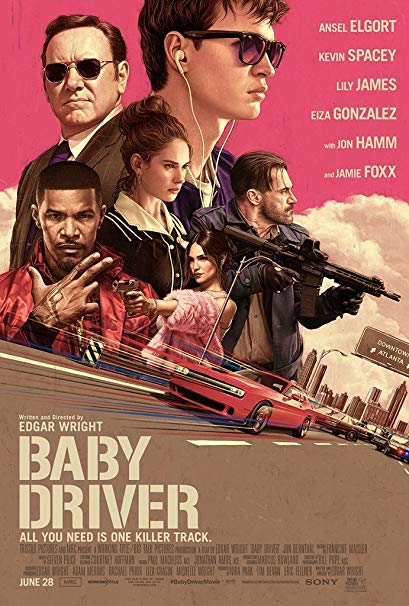
Edgar gets it Wright: Baby Driver

Contains spoilers

Baby Driver was easily my favourite film of 2017, and not without reason: it is an original take on a formulaic blend of car-chase/ heist thrillers, a musical romance with an intrusive soundtrack, and ultimately a masterful triumph. I am no film critic, but there are intrinsic details in the movie that demand careful appreciation even from a nobody’s viewing, regardless of the multiple BAFTAs, Academy Awards, Critics’ Choice and a Golden Globe.  Here I endeavour to unravel precisely why Edgar Wright hits all the right notes. If you haven’t watched the film, please do.

Simon and Garfunkel’s 1964 song Baby Driver perfectly captures the idea behind Edgar’s two-decade long passion project. ‘And I was born one dark gray morn with music coming in my ears. They call me Baby Driver. And once upon a pair of wheels I hit the road and I’m gone.’ The music of Baby Driver is what immediately captures our attention, and prevalent as a story-telling device throughout the film. I’ll save you from the endless praise about the musical device in Baby Driver-you can read that from countless professional reviews, but hear me out on a few gems of cinematic brilliance.

How does the music tell the storytelling? The famous opening scene says it all. 6 minutes with a no-dialogue, car-chasing action set in sync to Wright’s inspiration for the film- Bellbottoms by The Jon Spencer Blues Explosion. He had previously done a music video for Mint Royale’s Blue Song and the resemblance is uncanny. ‘When I listen to this song, I think of a car chase.’ Every jump, every cut is synced in time to the song, and Baby’s playful lip-syncing as he awaits the robbers’ return prepares us for a musically-infused thriller. Wright scripted the film directly to music he hand-picked, ignoring Quentin Tarantino’s warning against his unconventional method, saying it was too hard to secure rights to the music. Undeterred, Wright instructed his crew to completely follow the track when filming and this was fundamental to its success.

The tracking shot set to Harlem Shuffle by Bob & Earl was specifically edited by British DJ OSYMYSO to blend in to the sounds of the street, and choreographed with the help of Grammy-winning choreographer Ryan Heffington. Wright went to extreme lengths in order to merge film to music, one example being the added scene when Baby restarts the track on his iPod after changing cars because Neat Neat Neat by the Damned was too short to fit the scene. Baby Driver has become a masterclass in editing to the music, with many spotting the brilliance of Focus’ Hocus Pocus as the ‘perfect cardio track’ for the ever-changing tempo of the foot-chase scene, and the drums in The Button Down Brass’ Tequila synced to the gunshots in the action-packed gunfight.

Not only that, but critics have also noticed the combination of visual language and music to represent Baby’s form of escapism. Following his mother’s death, Baby listens almost constantly to music in order to drown out the grief. Interestingly, when Debora comes into his life, he no longer needs the constant music in his ears. Coincidence? I think not. Another manipulation of music and video editing is the long sweeping shots of non-chase scenes set to classical music compared to heavy rock action scenes, highlighting the drastic difference between Baby’s two worlds. The colour(and music)-coordinated turning of the washing machines in the Laundromat, the graffiti of matching lyrics, Buddy’s revenge scene set to Baby’s favourite song Brighton Rock by Queen and the lyrical detail ‘nowhere to run, Baby’ are merely the tip of the iceberg when it comes to musical details.

More in terms of storytelling: Baby’s morality and detest of violence is prevalent throughout, even in chase scenes- he edges the car forward to avoid seeing the robbery, and on multiple occasions save bystanders’ lives without jeopardizing the mission. Every detail serves a purpose in Wright’s film, and the high-flying car chases do not serve only to entertain thrill-seekers. We get the sense that Baby’s world is falling apart when during the drug deal, the camera averts from its persistent focus on only Baby and move to shots of the other characters, unprecedented in the entire movie.

Daniel Netzel from Film Radar also notes the use of colour-coded characters in Baby Driver. Costume designer Courtney Hoffman portrayed Baby’s innocence and alienation to his violent peers through his black and white costume. It epitomizes the contrast between his worlds and his old-fashioned, romantizised view of the world. This is also seen in the black and white nostalgic vision of his escape with Debora. Another Easter egg for you: Baby’s undershirt gets progressively darker to signify the collapse of his world.

The other characters’ costumes are also designed accordingly. Wright always remembered the effect the distinction of characters in his TV show Spaced had on his viewers. ‘The characters are all really easy to draw.’ Debora is dressed in the same black and white as Baby, representing innocence and goodness, whist some have noticed that she wears the exact same uniform that Baby’s mum had when she worked at the diner. Outside of work, Debora wears denim and the colour yellow, associated with happiness and literally brightening Baby’s black-and-white world. Bat’s vicious red echoes his violent character, with the colour also representing Buddy’s descent into madness as he is basked in red light from the police car in his final duel with Baby. Doc’s green is a common association with money and greed, yet his deep-seated attachment to Baby is seen through his nephew. The brief scene of the child depicts him in the same outfit as the young Baby in flashbacks: blonde hair, blue plaid shirt and earbuds.

Really these are blanket observations for a film with as much detail as Baby Driver, but with each new viewing, one should discover more and more of the ingenious intricacies of Edgar Wright’s work.

A Theme for the Ages: Paganini’s Caprice No.24 in A minor

Having played in various orchestras for the last ten years, I have been able to appreciate a variety of music available to wind players but never before has a melody remained so deeply etched in my memory as Fantasy Variations on a Theme of Paganini by James Barnes has. Yes, perhaps my attachment to the tune lies in the memories associated with it, but undeniably, the theme of Paganini is amongst the most iconic in classical music.

Wikipedia lists around 50 individual works as having been inspired by the Caprice No. 24 in A minor. Originally the final caprice in a collection of 24, Paganini’s piece has been widely regarded as one of the most difficult pieces written for the solo violin, with a multitude of virtuosic techniques including parallel octaves, extreme arpeggios and scales, quick string crossing, double stopping, and pizzicato on the left hand. Liszt transcribed the theme for piano in 1838 and from then on it has become a starting block for numerous variations. The theme has become a sort of Madonna and Child for composers, amongst them Brahms, Liszt, Chopin, Rachmaninoff and even the jazz clarinettist Benny Goodman.

I will first discuss the most famous variation from Paganini’s theme.

Rachmaninoff’s Rhapsody on a Theme of Paganini for solo piano and romantic period symphony orchestra was written in 1934. Its form closely resembles that of a concerto, though in a single movement. Rachmaninoff himself premiered the work in A minor with the Philadelphia Orchestra soon after, and arguably, redeemed his position as a composer after his Fourth Piano Concerto fell flat with audiences in 1926. Out of the 24 set of variations, by far the most well-known is variation 18 Andante cantabile in Dflat major. Ingeniously, Rachmaninoff creates the melody by flipping the A minor theme upside down, adding a few changes and converting the tune to a major key. He also uses another famous theme- Dies Irae (Day of Wrath), originally a Gregorian chant and adapted in Requiem mass works by Mozart, Berlioz, Stravinksy; more contemporary compoers such as Lutoslawski and Blacher; and even more recently the opening theme for Stanley Kubrick’s The Shining, A Clockwork Orange,  Sondheim’s Sweeney Todd, and Tobe Hooper’s Poltergeist. Here’s also a fun fact: the 24th Variation was so technically challenging to play that Rachmaninoff famously broke his own rule and drank a glass of Crème de Menthe to calm his nerves. After the hugely successful performance, Rachmaninoff nicknamed his 24th the ‘Crème de Menthe Variation’

So why exactly is Paganini’s theme so popular?

First of all, it is written in A minor. A minor is a ‘white note’ key- many composers regard its tonality as pure and hence easily suited for variation writing. The first half of the melody offers an alluring rhythmic dance between the shifts from tonic to dominant- examples of simple but effective classical harmony. The famous ‘Circle of Fifths’ is used in the second half, which means the music transitions smoothly from perfect cadence to perfect cadence- a device much used by the likes of Bach, Vivaldi and many others. More than anything, the rhythmic shape, harmonic progression and melody combine to form an infinitely memorable line- Paganini’s theme is just a special one-off in the history of music.

Variations lack the architectural complexity of sonata form, but it allows the composers to neglect the complex restrictions and explore intricate embellishments they are otherwise unable to do so. They remain an essential part of classical music, focusing on the journey rather than the destination, showcasing the virtuosic ability of solo players and composers alike.

Back to James Barnes. He had always wanted to write a set of variations on Paganini’s theme for years, before the opportunity arose when the US Marine Band commissioned him to do so in 1987. ‘I would wake up in the middle of the night and hurry to write another variation. I rushed to finish sketching this work so I could get that silly little tune out of my head.’ He stuck with the original A minor out of respect for Paganini’s original, and wrote the piece with the intention that every solo instrument and section of the Marine Band could be showcased.

Here is the best version of Fantasy Variations I have heard

Our wind orchestra went on to win the trophy at a highly competitive music festival, defeating our rival college in an emotional triumph. I still well up at the sound of the saxophone solo.

A Bigger Splash

A Bigger Splash –David Hockney, 1967

A Bigger Splash 1967 David Hockney born 1937 Purchased 1981 http://www.tate.org.uk/art/work/T03254

 (Hockney, 1967)

I came across this striking painting whilst visiting the Tate in London on a school trip. What captured my attention was the Californian impression captured by the bold monotonous colours of turquoise and pink, with the predominant horizontal building directly in contrast with a splash of white in the centre.

A Bigger Splash is the largest of a collection of three paintings by Hockney depicting splashes, the other two being A Splash and A Little Splash.  Hockney, born in England, visited Los Angeles in 1964 and subsequently fell in love with the hot climate and sensual, relaxed lifestyle. He painted a series of works all depicting swimming pools between 1964-71, and experimented with different techniques to explore the changing form of water surfaces, with influences including Bernard Cohen and Jean Dubruffet.

Hockney had recently discovered the benefits of fast-drying acrylic paint- Liquitex, a relatively new medium compared to the traditional oil paint, which he deemed more visually appropriate for the hot, parched climate of California.

With regards to the composition of the painting, what immediately stands out is the predominantly horizontal perspective. The view of the swimming pool rests on the background of a low-lying 60s modernist house. A sense of balance is achieved through the equal division of sky, building and patio on the upper half against the pool on the lower half.  The startling oblique diving board juts out from the foreground adds to the sense of perspective. It is interesting to note the subtle details used to emphasize the splash- the slightly thicker white line on the building’s flat roof is marked at the same vertical line as the splash, and the splash itself being in line with the diagonal diving board.

The colours of the painting resonate with the contrast of the diving board- the yellow at odds with the turquoise water and sky. The monotonous blocks of colour were actually rollered onto the canvas before Hockney uses a smaller brush to add in the detail of the chair, reflections, trees and grass.  Overall the painting is created through a constrained palette, mixing or applied as tints colours such as ultramarine blue, cobalt blue, Naples yellow, Hooker’s green, titanium white, and raw and burnt sienna. Also typical of Hockney’s style at the time was leaving raw canvas on the border. In this case it extends to within the painting itself- under careful observation, one would notice that a thin line of the pool’s edge is actually left unpainted.

A Bigger Splash was based on a photograph Hockey found in a book about building swimming pools. The raw canvas on the outside, leaving a near perfect square, is perhaps indicative of a Polaroid effect.  Hockney acknowledges how seeing a splash on painting is even more striking than on photo- it cannot be frozen in time. He later went on to create portraits through collages of the same subject on different photographs taken over a period of time.

‘When you photograph a splash, you’re freezing a moment and it becomes something else. I realise that a splash could never be seen this way in real life, it happens too quickly. And I was amused by this, so I painted it in a very, very slow way.’ [1] Hockney took two weeks to complete the painting, with the majority of the time spent painting the central splash with a variety of very small brushes, and he noted the irony of taking a considerable amount of time to capture a fleeting moment.


[1] Catherine Kinley, David Hockney: Seven Paintings, exhibition brochure, Tate Gallery, London 1992, reproduced [p.5] in colour